If you run a restaurant, cafeteria or catering kitchen, you have probably asked for a cleaning quote and wondered why two numbers for the same kitchen can look so different. The answer is usually scope. Commercial kitchen cleaning services are not priced off a menu, because no two kitchens have the same size, equipment, grease load or schedule. Once you know what drives the price, and what is often quoted as a separate job, comparing quotes gets much easier.
This guide walks Michigan restaurant owners and kitchen managers through what a full kitchen cleaning usually covers, the factors that move the price up or down, the services that tend to be priced on their own and a few simple ways to compare quotes fairly.
What Commercial Kitchen Cleaning Services Usually Include
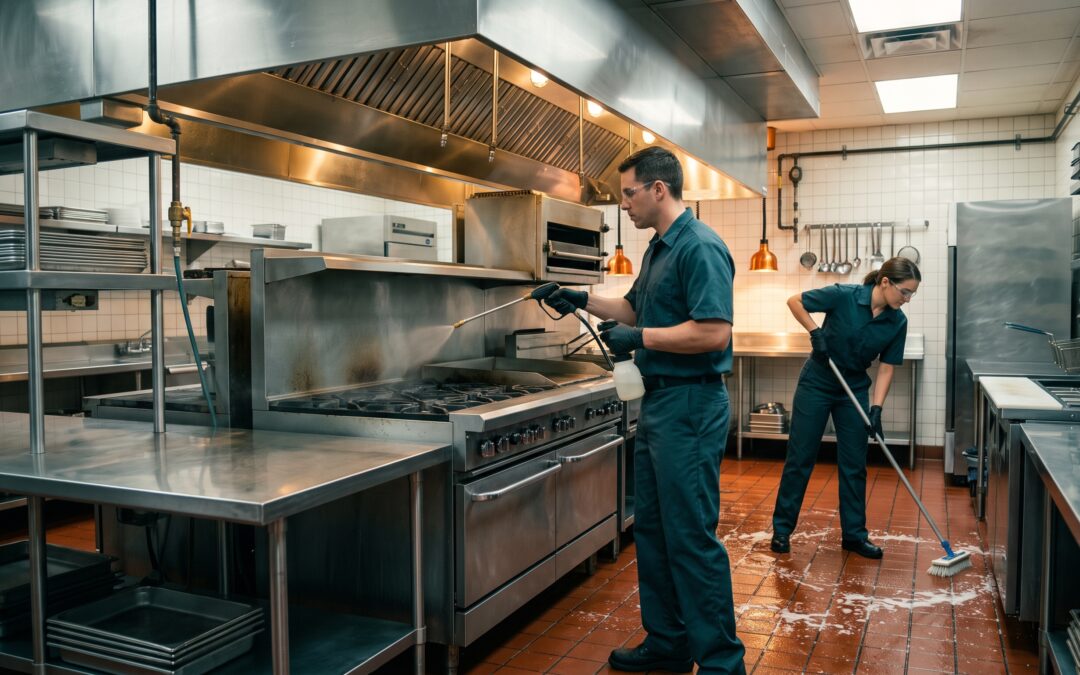
A full kitchen cleaning is a top-to-bottom job, not a quick wipe-down at close. The exact scope depends on your kitchen and the services you choose, but a full cleaning can include:
- Cooking equipment: griddles, charbroilers, fryers and the rest of the line, cleaned and sanitized.
- Walls and surfaces: grease and splatter removed from walls, backsplashes and prep areas.
- Floors: degreasing the floor, including the areas around and under equipment.
- Hard-to-reach areas: the spots behind and under equipment where buildup collects and daily cleaning rarely reaches.
Professional cleaning does not replace the daily cleaning your staff already does. It handles the heavy grease and the hard-to-reach buildup that daily routines leave behind, so your team can keep up with the rest between visits.

What Drives the Price of a Full Kitchen Cleaning
Pricing varies based on kitchen size, condition, equipment, grease levels and accessibility. Here is how each of those plays out in a real quote.
Kitchen size and layout
More square footage means more floor, more wall and more surfaces to degrease. Layout matters too. A long, narrow line with equipment packed tight takes more time than an open kitchen with room to move, and a kitchen with separate prep rooms, a bakery area or a dish room adds to the scope.
Equipment count
Every fryer, griddle, charbroiler, range and oven adds time. A cafe with a small cook line is a very different job from a high-volume restaurant or a banquet kitchen with several stations. When you ask for a quote, have a rough list of your equipment ready so the estimate reflects what is actually in the kitchen.
Grease level and condition
A kitchen that is cleaned on a regular schedule takes less effort than one with months of heavy buildup. Carbonized grease on equipment, sticky film on walls and grease that has worked into floor corners all take longer to remove. The first deep cleaning in a while often costs more than the maintenance visits that follow, because the crew is catching up on old buildup.
Access and scheduling
Accessibility affects how quickly a crew can work: equipment that can be pulled out, clear paths to the back door and space to stage supplies all help. Timing matters too. Most kitchens cannot shut down during service, so cleaning happens late at night, early in the morning or on a day you are closed. We offer after-hours scheduling and work around your hours, so ask how timing fits into the quote you receive.
How often you book
Frequency is one of the biggest levers on long-term cost. Kitchens that book regular cleanings tend to stay in better shape, which keeps each visit simpler. Kitchens that wait until there is a problem usually face a bigger job when they finally call.
What Is Often Quoted Separately
Some of the most important kitchen services are priced as their own line items, because they follow their own schedules and involve different equipment. Expect to see these quoted on their own:
- Hood and exhaust cleaning: kitchen hood cleaning covers the hood and the exhaust system above the line, and it may be quoted separately from a full kitchen cleaning. Our post on what Detroit kitchens pay for hood work explains what changes that price.
- Grease trap service: a grease trap cleaning service removes fats, oils and grease, vacuums out solids, scrapes the baffles, clears blockages and comes with a detailed report. We set up regular trap cleanings every one to three months. See what Michigan restaurants pay for trap service for more.
- Floor care: deep floor degreasing and other floor work can be added to a kitchen cleaning or booked on its own through our commercial floor care.
- Ceilings: kitchen ceilings collect grease and dust over time and can be cleaned as part of a larger job or as a separate service.
Bundling some of these with a full kitchen cleaning can save a second visit and a second round of after-hours work. Ask for each service as a line item, so you can see what you are paying for and decide what to schedule now and what can wait.
How to Compare Quotes Fairly
A low number is not a good deal if it covers half the work. Before you choose, check a few things:
- Get the scope in writing: the quote should list the equipment, walls, floors and other areas that will be cleaned.
- Ask what is not included: confirm whether hoods, grease traps, floors and ceilings are in the price or quoted separately.
- Ask about timing: make sure the quote reflects when the work will happen, whether that is overnight or on a closed day.
- Ask for an on-site look: a price given over the phone cannot account for grease levels, equipment count or access. A walkthrough can.
When two quotes cover the same scope, at the same time of day, for the same equipment, you can compare them fairly.
Frequently Asked Questions
How much does it cost to have a commercial kitchen cleaned?
It depends on kitchen size, condition, equipment, grease levels and accessibility, plus when the work is scheduled. An on-site estimate is the most reliable way to get a real number for your kitchen.
Is hood cleaning included in a full kitchen cleaning?
Not always. Hood and exhaust work may be quoted separately because it involves the hood and exhaust system and follows its own schedule. Check your quote to see whether it is listed.
Does after-hours cleaning cost more?
Ask each provider how timing affects the quote. We offer after-hours scheduling, including late nights and early mornings, so your kitchen is ready for the next service.
How often should a commercial kitchen be professionally cleaned?
It depends on how busy the kitchen is and how much grease it produces. High-volume kitchens need professional cleaning more often than small cafes, and regular visits keep each job simpler than waiting for buildup.
Get a Free Estimate for Your Kitchen
The best way to know what your kitchen will cost is to have someone look at it. D Poole Commercial Kitchen Cleaning is a veteran-owned company that has served Michigan since 1979, with crews available 24/7 and after-hours scheduling that keeps your kitchen open for business. Our commercial kitchen cleaning services cover cooking equipment, floors, walls and hard-to-reach areas, along with hood, duct and grease trap work when you need it.
Learn more about our full kitchen and equipment cleaning across Michigan, or call or text (810) 287-2468 for a free estimate. New customers can save $200 on their first full kitchen cleaning (one per customer, valid for 90 days from the day you claim it).