Your kitchen may look clean at the end of the night, but that does not necessarily mean the entire kitchen is getting cleaned.
Your staff can wipe prep surfaces, mop floors, wash utensils, empty trash, and clean the equipment they use every day. The challenge is everything that accumulates outside that routine. Grease works its way behind cooking equipment. Residue builds along walls and floors. Exhaust components collect grease that is not visible from the cooking line. Areas that are difficult to reach are also the easiest to postpone during a busy closing shift.
For a Flint restaurant owner, allowing those problems to build can eventually mean more than having a dirty kitchen. It can make equipment harder to maintain, create persistent odors, increase grease-related fire concerns, complicate inspections, and turn what could have been routine cleaning into a much larger job.
Knowing what professional commercial kitchen cleaning in Flint, MI should actually include, which parts of the kitchen need different cleaning schedules, and what to expect from a cleaning company can help you build a program that fits the way your restaurant really operates.
Routine Kitchen Cleaning and Professional Deep Cleaning Serve Different Purposes
Your employees should already be handling a substantial amount of cleaning as part of normal restaurant operations.
Michigan food-safety guidance requires food-contact surfaces and utensils to be routinely cleaned and sanitized. It also distinguishes between the two steps. Cleaning removes food, grease, soil, and debris, while sanitizing comes afterward to reduce microorganisms on an already-clean surface.
That daily work is essential, but professional deep cleaning addresses a different problem.
During service, your team has limited time. Employees are concentrating on food preparation, customer orders, closing tasks, inventory, and getting the kitchen ready for the next shift. Moving heavy equipment, degreasing difficult surfaces, or dismantling areas that require more involved cleaning may not be realistic every night.
Over time, those skipped or inaccessible areas become the places where buildup becomes most difficult to remove.
Professional cleaning should complement your staff’s routine rather than replace it. A useful cleaning plan identifies which tasks belong on daily and weekly employee checklists and which jobs need to be scheduled separately.
What Should Commercial Kitchen Cleaning Include?
The scope depends on your kitchen. A small café without heavy frying will not have the same cleaning demands as a high-volume restaurant operating fryers, grills, charbroilers, or pizza ovens for long hours.
That is why the scope should be established before the work begins rather than assuming every “deep clean” includes the same services.
Cooking Equipment and the Areas Around It
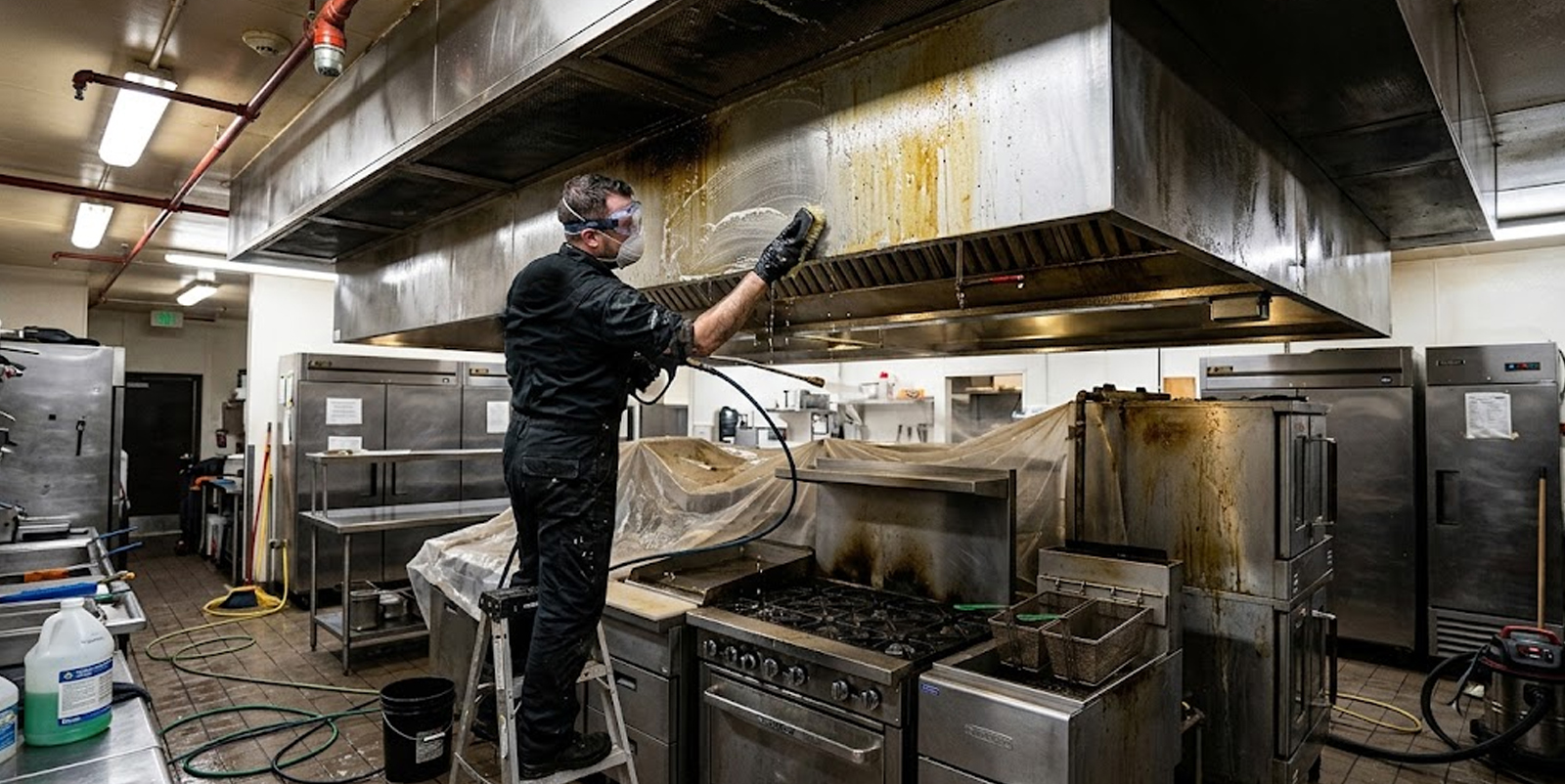
Cooking equipment is one of the most obvious places for grease and food residue to accumulate, but the visible surfaces are only part of the job.
Depending on the equipment and agreed scope, professional cleaning may address:
- Ovens and pizza ovens
- Fryers
- Grills and griddles
- Ranges
- Refrigeration exteriors
- Stainless steel surfaces
- Equipment sides and bases
- Areas underneath movable equipment
- Walls and floors behind the cooking line
The surrounding spaces matter because grease does not stay neatly on the appliance where it originated. Heat, splashing oil, steam, foot traffic, and normal food preparation spread residue across nearby surfaces.
A kitchen can therefore have clean-looking equipment while still having significant buildup behind and beneath it.
Floors, Walls, Ceilings, and Difficult-to-Reach Areas
Daily mopping can remove loose soil from an open floor, but it may not remove grease embedded in grout, corners, edges, and areas beneath equipment.
The same issue occurs on walls, ceilings, shelving, lighting areas, and other surfaces that are not part of every closing checklist.
These areas should not be ignored simply because they do not touch food directly. Greasy floors can become slippery. Residue behind equipment can contribute to odors and pest concerns. Heavy buildup also becomes progressively harder to remove.
Professional cleaning gives you an opportunity to address those neglected areas before they become a recurring operational problem.
Hood, Duct, and Exhaust System Cleaning
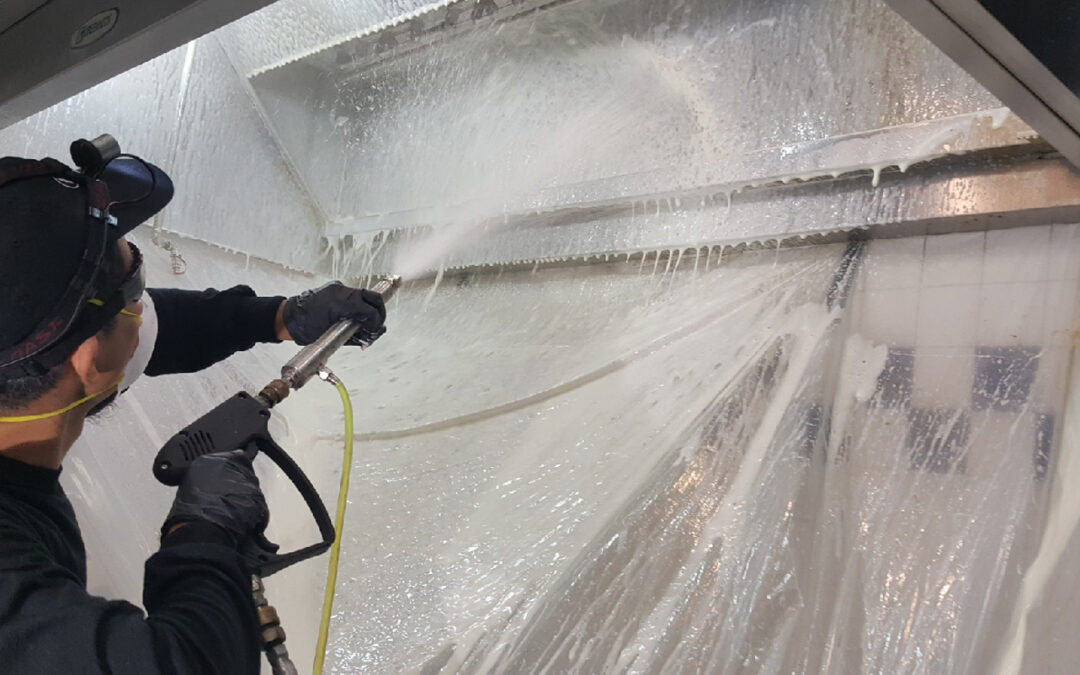
Restaurant exhaust cleaning deserves separate attention because wiping the visible hood is not the same as cleaning the exhaust system.
Grease-laden vapors can move through filters, ductwork, fans, and other exhaust components. NFPA 96 uses cooking type and volume to determine inspection frequency for grease buildup, with more frequent inspection expected for operations such as solid-fuel or high-volume cooking.
That distinction matters when reviewing a commercial kitchen cleaning proposal.
Do not assume that “hood cleaning” automatically includes every part of the exhaust system. Ask specifically what will be cleaned, how access will be handled, and whether the service covers the hood, filters, ductwork, fan, and other applicable components.
How Often Should a Flint Restaurant Schedule Professional Cleaning?
There is no useful one-size-fits-all answer such as “every restaurant needs a complete professional deep clean every six months.”
A better schedule starts with what your kitchen actually produces.
Consider:
- How many hours the kitchen operates
- How much food you prepare
- Whether you fry, grill, charbroil, bake, or use solid fuel
- How quickly grease develops around equipment
- How often equipment can realistically be moved
- Which tasks your employees already complete
- The condition of floors, walls, ceilings, and other surfaces
- Manufacturer maintenance instructions
- Applicable health, fire, and mechanical requirements
A high-volume Flint restaurant operating from morning through late evening may need certain areas addressed much more frequently than a lower-volume operation with limited cooking.
Different parts of the same kitchen may also require different schedules.
Your floors and prep areas may receive attention every day. Areas behind equipment may be included in a periodic deep clean. Your grease trap may follow another service schedule. Your exhaust system should be inspected and cleaned according to its grease accumulation, cooking conditions, and applicable requirements.
The goal is not to pick one convenient frequency for the entire building. It is to prevent each area from reaching the point where buildup becomes a problem.
Why Cleaning Matters During Flint Restaurant Inspections
Restaurants in Flint and the surrounding Genesee County area operate within an active local food-service inspection system. The Genesee County Health Department’s Food Service program licenses and inspects food establishments, responds to complaints and foodborne-illness concerns, and carries out enforcement activities when necessary.
Professional cleaning does not guarantee that a restaurant will pass an inspection. Cleaning companies also do not replace the restaurant operator’s responsibility for food handling, temperatures, employee hygiene, storage, pest control, equipment condition, and other regulated practices.
What professional cleaning can do is help you address physical buildup that routine operations may leave behind.
The better approach is to maintain the kitchen continuously rather than trying to predict when an inspector might arrive.
If grease, residue, or sanitation problems have been building for months, an emergency cleaning immediately before an inspection may not address the underlying gaps in your maintenance schedule.
Warning Signs That Your Current Cleaning Schedule May Not Be Enough
You do not necessarily need to wait for an inspection or obvious sanitation problem before reviewing your cleaning program.
Look more closely when you notice:
- Grease returning quickly after routine cleaning
- Sticky floors around cooking equipment
- Darkened grout or buildup along floor edges
- Persistent odors after closing
- Heavy residue behind or underneath appliances
- Greasy walls near the cooking line
- Difficult-to-clean equipment surfaces
- Visible exhaust grease accumulation
- Staff repeatedly skipping deep-cleaning tasks because of time
- Cleaning problems reappearing in the same locations
One warning sign by itself does not automatically mean you need a complete kitchen deep clean. Repeated buildup, however, can indicate that the frequency, cleaning method, or division of responsibility needs to change.
What Should You Ask a Commercial Kitchen Cleaning Company?
Price matters, but comparing quotes based only on the total at the bottom of the estimate can be misleading.
Two companies may both offer “commercial kitchen cleaning” while including completely different work.
Before hiring a provider, ask:
What exactly is included?
Get clarity on equipment, floors, walls, ceilings, exhaust components, drains, and any specialty areas.
What is excluded?
Knowing what is not part of the service prevents assumptions and surprise charges.
Does equipment need to be moved?
Some areas cannot be cleaned properly without access behind or beneath appliances.
How will the service affect operating hours?
Restaurants often need work performed after closing or during other low-impact periods.
Is exhaust cleaning included or quoted separately?
Never assume the visible hood and entire exhaust system are the same service.
Can the schedule be adjusted to the kitchen’s actual usage?
Cleaning frequency should reflect your operation rather than an arbitrary package.
Will the scope and price be clear before work starts?
A detailed estimate makes it easier to compare providers and understand what you are paying for.
These questions help you evaluate the actual service rather than choosing a company based on the lowest number without knowing what that number covers.
Build a Cleaning Schedule Around Your Flint Kitchen
Commercial kitchen cleaning works best when it is planned around the way your restaurant operates rather than treated as a last-minute response to visible grease or an upcoming inspection.
Your staff should continue handling the daily cleaning and sanitizing required to keep the kitchen functioning safely. Professional service can then target the heavy buildup, difficult access points, equipment areas, floors, exhaust components, and other work that falls outside the normal closing routine.
D Poole Commercial Kitchen Cleaning has served Michigan commercial kitchens since 1979 and provides commercial kitchen cleaning in Flint, MI and Genesee County. The company offers customized cleaning plans designed around the kitchen and operating schedule.
If you are unsure whether your current cleaning routine is keeping up with your restaurant, start by identifying where grease and residue are accumulating between cleanings. From there, you can build a professional cleaning schedule around the areas that actually need attention instead of waiting until buildup becomes harder and more expensive to address.
Frequently Asked Questions About Commercial Kitchen Cleaning in Flint, MI
How much does commercial kitchen cleaning cost in Flint, MI?
Pricing depends on factors such as kitchen size, equipment, grease buildup, accessibility, cleaning scope, labor involved, and whether specialty services are included. A walkthrough, photos, or video of the kitchen can help a cleaning company provide a more accurate estimate.
How long does professional commercial kitchen cleaning take?
A smaller kitchen with moderate buildup may require considerably less time than a large or high-volume restaurant with numerous appliances and difficult-to-access areas. The scope should be reviewed before service so you understand how much downtime may be required.
Can professional kitchen cleaning be done after the restaurant closes?
Often, yes. Scheduling cleaning outside normal operating hours can reduce disruption to restaurant service. D Poole states that its cleaning services can be scheduled around a commercial kitchen’s operating hours.
Is restaurant hood cleaning part of a normal kitchen deep clean?
Not necessarily. Hood and exhaust cleaning may be a separate service with its own scope and schedule. Ask whether the quote includes only visible hood surfaces or the filters, ducts, exhaust fan, and other system components.
How often should a restaurant hood exhaust system be inspected?
NFPA 96 bases grease-buildup inspection frequency on the type and volume of cooking. Solid-fuel and high-volume cooking operations generally require more frequent attention than lower-volume operations. The applicable code edition and local authority requirements should be confirmed for your facility.
Does professional cleaning replace daily employee cleaning?
No. Employees still need to complete routine cleaning and sanitizing throughout normal operations. Professional cleaning is most useful for deeper work, difficult access areas, heavy grease buildup, and tasks that do not fit easily into daily closing procedures.
What is the difference between cleaning and sanitizing?
Cleaning removes food, soil, grease, and other debris. Sanitizing takes place after cleaning and reduces microorganisms on the cleaned surface. Michigan food-safety guidance specifically treats these as separate steps.
Should equipment be moved during a commercial kitchen deep clean?
It depends on the equipment and scope. If grease and food debris are accumulating behind or beneath movable appliances, access to those areas may be necessary. Heavy equipment should only be moved when it can be done safely and without damaging utilities or connections.
Can deep cleaning help with persistent kitchen odors?
It can when the odor is associated with accumulated grease, food residue, floors, equipment areas, or other dirty surfaces. Persistent odors can also come from drains, plumbing, grease traps, pests, or equipment problems, so the source should be identified rather than assuming cleaning alone will resolve it.
What should I do before a professional kitchen cleaning appointment?
Ask the cleaning company what preparation is required. You may need to remove or protect food, clear certain work areas, coordinate equipment access, and make sure employees know which portions of the kitchen will be unavailable during service.
How do I know if my restaurant needs professional deep cleaning?
Look for repeated grease buildup, sticky floors, residue behind equipment, persistent odors, difficult-to-clean surfaces, and areas that employees consistently cannot reach during routine cleaning. Those patterns can indicate that your current schedule is no longer keeping up with the operation.
Does D Poole provide commercial kitchen cleaning in Flint, Michigan?
Yes. D Poole lists Flint and Genesee County among its Michigan service areas and provides commercial kitchen cleaning, deep cleaning, and related services for commercial kitchens.