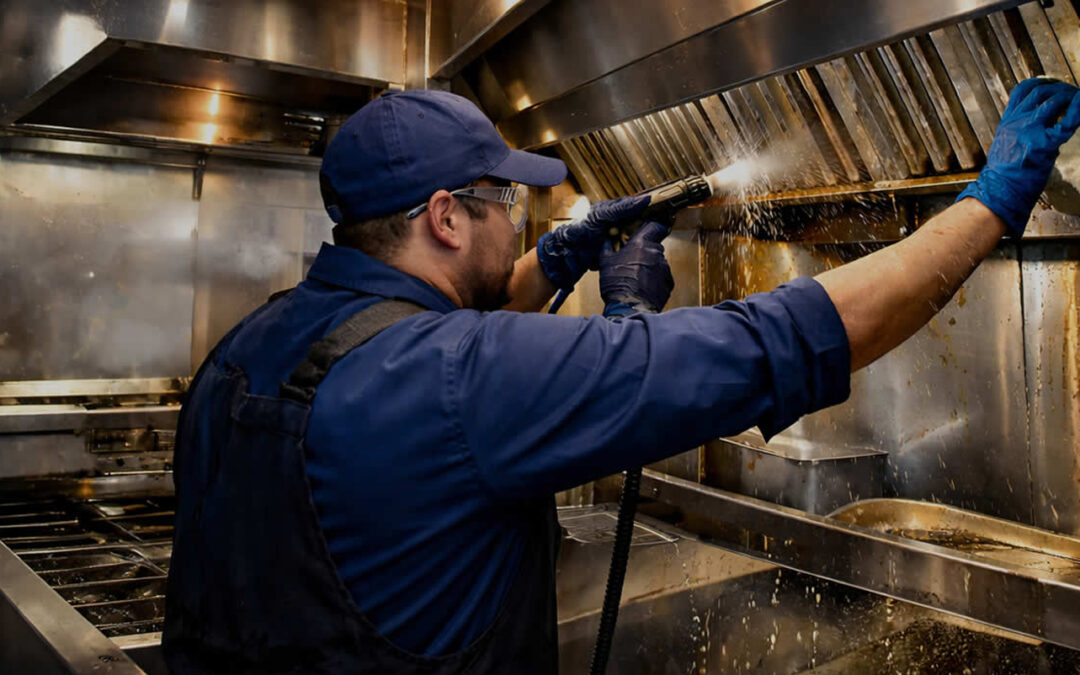
You can clean your commercial kitchen every day and still find grease, food residue, and grime building up in places your closing crew rarely reaches.
That does not necessarily mean your employees are doing a poor job. Daily cleaning is designed to keep the kitchen ready for service, which means attention naturally goes to food-contact surfaces, cooking equipment, open floors, utensils, and immediate messes. Moving equipment, degreasing walls, scrubbing beneath appliances, and tackling overhead surfaces can be much harder to fit into an already demanding closing routine.
The problem begins when those postponed jobs stay postponed. Grease becomes harder to remove, floors remain sticky after mopping, odors return, equipment areas become increasingly difficult to maintain, and buildup may spread into parts of the kitchen you cannot easily see.
Commercial kitchen deep cleaning is intended to close that gap, but deciding what should be included and how often it needs to happen depends heavily on the way your kitchen operates. Knowing where daily cleaning ends and deeper work begins can help you build a schedule that addresses problems before they become significantly harder to manage.
What Is the Difference Between Daily Cleaning and Deep Cleaning?
Routine cleaning and deep cleaning are not competing approaches. A commercial kitchen needs both.
Your employees handle the cleaning required to keep food preparation and normal operations running safely from one shift to the next. That includes tasks such as cleaning work surfaces, washing utensils, addressing spills, cleaning cooking equipment, sweeping, mopping, and taking care of other areas used throughout the day.
The FDA Food Code, which serves as a model for food-safety regulations adopted by state and local authorities, requires food-contact surfaces to be kept clean and establishes cleaning frequencies for different types of equipment and uses. It also states that non-food-contact equipment surfaces should be cleaned often enough to prevent soil accumulation.
Commercial kitchen deep cleaning goes further.
It focuses on accumulated grease, difficult access points, and surfaces that may not receive thorough attention during normal cleaning. Instead of replacing your employees’ routine, it gives you a way to address the work that is too involved, time-consuming, or specialized for an ordinary closing shift.
What Does Commercial Kitchen Deep Cleaning Include?
There is no universal deep-cleaning package. The appropriate scope depends on the kitchen, equipment, cooking volume, current condition, and services you have requested.
That is why you should establish the scope before the work begins rather than assuming the words “deep clean” cover every surface and system.
Cooking Equipment and the Areas Around It
Cooking equipment is usually one of the biggest sources of grease and food residue.
Depending on the service agreement, deep cleaning may address:
- Fryers
- Grills and griddles
- Ranges
- Ovens and pizza ovens
- Equipment exteriors
- Stainless steel surfaces
- Equipment legs, wheels, and bases
- Sides of appliances
- Accessible areas behind and underneath equipment
The last two items are particularly important.
An employee may thoroughly clean the front and top of a fryer every night while grease continues accumulating underneath it. The same problem can occur between appliances and along walls that cannot be reached without moving equipment or using specialized cleaning tools.
Removing that hidden buildup is one of the biggest differences between surface-level maintenance and an actual deep clean.
Floors, Grout, Walls, and Base Areas
Daily mopping deals with fresh spills and loose soil. It does not always remove grease that has worked into textured flooring, grout lines, corners, and floor edges.
Deep floor cleaning may include scrubbing areas around and beneath equipment, degreasing floor surfaces, working on tile and grout, and addressing buildup along wall-to-floor junctions.
Walls near cooking equipment can require similar attention.
Splattered oil and airborne grease can gradually create a sticky film that attracts additional dirt. Once the buildup has been allowed to harden, a quick wipe during closing may no longer be enough.
Shelving, Storage Areas, and Difficult-to-Reach Surfaces
Some of the easiest areas to overlook are those employees do not interact with continuously.
A deeper cleaning program may include:
- Storage racks and shelving
- Exterior refrigerator and freezer surfaces
- Sink and dishwasher areas
- Drain surroundings
- Waste areas
- Ceiling surfaces
- Lighting areas
- Air vents
- Handles, switches, and other frequently touched surfaces
D Poole, for example, lists equipment cleaning, floor and wall degreasing, storage racks, areas behind appliances, tile and grout, ceilings, lighting, air vents, and other kitchen surfaces among its commercial kitchen cleaning services.
Not every kitchen will require all of these items during every visit. The purpose of the initial evaluation is to identify where buildup is occurring and create a scope around those conditions.
Is Hood Cleaning Part of a Commercial Kitchen Deep Clean?
It can be, but you should never assume it is.
Restaurant hood and exhaust cleaning is a specialized service involving more than the visible stainless steel canopy over your cooking line. Grease-laden vapors can travel through grease-removal devices, ductwork, fans, and other portions of the exhaust system.
If a proposal says “hood cleaning,” ask what that actually means.
A complete exhaust cleaning service may involve components such as:
- Hood interiors
- Filters or baffles
- Ductwork
- Exhaust fans
- Accessible grease-contaminated exhaust components
This work also follows a different maintenance logic from general kitchen deep cleaning.
NFPA 96 establishes inspection frequencies for grease buildup based on the cooking operation. Under the 2024 edition, systems serving solid-fuel cooking operations are inspected monthly, high-volume operations quarterly, moderate-volume operations semiannually, and low-volume operations annually. Cleaning is then required when inspection finds grease contamination that requires removal.
Those are exhaust-system inspection intervals, not a universal schedule for deep cleaning the rest of your kitchen.
That distinction is important when building your maintenance calendar.
How Often Should You Schedule Commercial Kitchen Deep Cleaning?
There is no reliable answer such as “every restaurant should deep clean once every three months.”
A kitchen that runs fryers and charbroilers from early morning until midnight creates very different conditions from a small café serving a limited menu.
Your schedule should reflect how quickly each area becomes dirty.
Factors that can change your cleaning frequency include:
- Daily cooking volume
- Hours of operation
- Amount of frying or grilling
- Type and number of cooking appliances
- Number of meals served
- Employee cleaning routines
- Accessibility behind equipment
- Grease accumulation
- Floor condition
- Previous cleaning history
- Seasonal increases in business
Instead of setting one frequency for the entire kitchen, divide cleaning into categories.
Some tasks belong on every shift. Others may be weekly or monthly. Areas behind large equipment might require scheduled periodic cleaning. Hood and exhaust systems should follow their own inspection and cleaning requirements. Grease traps may need another schedule entirely.
This makes the plan much more useful than choosing one arbitrary “deep-clean day” for everything.
What Are the Signs Your Kitchen Needs a Deep Clean?
The calendar is not your only indicator.
The physical condition of your kitchen can show you when your current schedule is no longer keeping up.
Watch for:
- Floors that remain sticky after normal mopping
- Dark or heavily soiled grout
- Persistent grease film near cooking equipment
- Strong odors that return shortly after cleaning
- Food debris underneath equipment
- Heavy buildup behind appliances
- Greasy walls near fryers or grills
- Dirty equipment bases, casters, and legs
- Residue accumulating along floor edges
- Overhead areas that have not been cleaned for an extended period
- Employees repeatedly skipping the same cleaning tasks because they require too much time
Recurring problems deserve particular attention.
If your crew thoroughly cleans an area but it becomes difficult to maintain again almost immediately, the issue may be the cleaning frequency, access, method, or amount of grease being produced nearby.
A professional deep clean may address the buildup that is already there, but you should also determine how to keep the same problem from returning.
Should Your Staff or a Professional Handle the Deep Cleaning?
Your employees can handle many periodic cleaning tasks when they have enough time, appropriate training, suitable cleaning products, and safe access.
Other work may be better suited to professional service.
Consider outside help when cleaning requires moving substantial equipment, working with extensive grease buildup, using specialized tools, accessing difficult areas, or cleaning systems such as commercial kitchen exhaust ductwork.
You should also think about the operational cost of assigning the work internally.
A task that takes a professional crew several focused hours may require your employees to stay late across multiple shifts. That does not automatically make professional cleaning less expensive, but labor time, disruption, equipment, and cleaning effectiveness all belong in the comparison.
Safety matters as well. Equipment with gas, electrical, plumbing, or ventilation connections should not be casually disconnected or moved simply to reach a dirty surface.
How to Prepare for a Professional Kitchen Deep Clean
Preparation can make the cleaning more efficient and reduce unnecessary downtime.
Before the crew arrives, confirm which areas will be serviced and what your employees need to do beforehand.
Depending on the scope, preparation may involve:
- Removing or protecting food
- Clearing countertops and prep areas
- Emptying specified shelving
- Coordinating equipment access
- Identifying appliances that should not be moved
- Making sure the kitchen is no longer in active food production
- Providing access to locked rooms or equipment areas
You should also understand what is excluded from the service.
If grease trap cleaning, hood cleaning, equipment interiors, or particular appliances require separate authorization, knowing that before the job prevents surprises afterward.
Build Your Deep-Cleaning Schedule Around the Kitchen You Actually Run
Commercial kitchen deep cleaning is most effective when it fills the gaps your routine cleaning cannot reasonably cover.
That does not mean every surface needs professional attention on the same schedule. A better approach is to look at where grease and residue accumulate, how quickly they return, what your staff can realistically maintain, and which systems have separate inspection or cleaning requirements.
D Poole Commercial Kitchen Cleaning has served Michigan commercial kitchens since 1979 and provides deep cleaning for equipment, floors, walls, difficult-to-reach areas, and other parts of restaurant kitchens, along with specialized services such as hood and exhaust cleaning.
If the same buildup keeps returning or important areas have gone too long without thorough cleaning, a professional evaluation can help you determine what needs attention now and establish a schedule that is more realistic for your operation.
Frequently Asked Questions About Commercial Kitchen Deep Cleaning
How much does commercial kitchen deep cleaning cost?
Cost depends on kitchen size, equipment, amount of grease buildup, accessibility, labor requirements, and the areas included in the service. Exhaust cleaning, grease trap cleaning, or other specialized work may be priced separately. An estimate based on the actual kitchen is more useful than a generic price per square foot.
How long does a commercial kitchen deep clean take?
The time required can range significantly depending on the kitchen. A small operation with moderate buildup will take less time than a high-volume restaurant with numerous appliances and difficult-to-access grease. The cleaning company should evaluate the scope before giving you an expected service window.
Can a commercial kitchen be deep cleaned overnight?
Often, yes. Off-hours cleaning is common because it allows crews to access equipment and work areas without interfering with food production. D Poole states that it offers flexible scheduling around commercial kitchen operating hours.
How often should floors in a commercial kitchen be deep cleaned?
Daily floor cleaning should continue as part of normal kitchen maintenance. More intensive scrubbing or degreasing depends on how quickly grease accumulates, the flooring material, cooking volume, and whether routine mopping is still effectively keeping the surface clean.
Does deep cleaning include sanitizing?
Not automatically. Cleaning and sanitizing are separate processes. Cleaning removes soil, food residue, and grease, while sanitizing is performed after appropriate cleaning where required. Confirm which surfaces the service will clean, sanitize, disinfect, or otherwise treat.
Is commercial hood cleaning the same as kitchen deep cleaning?
No. Hood and exhaust cleaning is a specialized service addressing grease accumulation within the commercial cooking ventilation system. It may be offered alongside a kitchen deep clean, but it should have a clearly defined scope and maintenance schedule.
Do you need to move restaurant equipment for deep cleaning?
Sometimes. Grease and food debris commonly accumulate underneath and behind appliances. Movable equipment may need to be repositioned, but appliances connected to gas, plumbing, electrical, or ventilation systems require proper precautions. Confirm who is responsible for equipment movement before cleaning begins.
Can restaurant employees perform their own deep cleaning?
Yes, some deep-cleaning work can be handled internally when staff have the necessary time, training, equipment, and safe access. Professional service becomes useful when the work involves heavy grease, difficult access, specialized systems, or tasks that cannot realistically fit into the normal employee cleaning schedule.
What happens if you do not deep clean a commercial kitchen?
Buildup can become progressively harder to remove and may contribute to odors, slippery surfaces, pest-attracting residue, difficult equipment maintenance, and grease-related fire concerns. Neglected areas can also require more extensive cleaning once they are finally addressed.
How do you know if a commercial kitchen cleaning company is doing a true deep clean?
Ask for a written scope. It should make clear which equipment, floors, walls, areas behind appliances, overhead surfaces, and specialty systems are included. Before-and-after documentation can also help show what areas were actually serviced.
Should every part of the kitchen be deep cleaned at the same frequency?
No. Different areas accumulate soil at different rates. Food-contact surfaces may need attention throughout each day, floors require routine cleaning, equipment areas may need scheduled periodic service, and hood and exhaust systems follow separate inspection and cleaning requirements. A layered schedule is usually more practical than one frequency for the entire kitchen.