A piece of equipment goes down in the middle of service and the immediate instinct is to get it fixed as fast as possible. That instinct is usually right. But once the emergency passes, a more important question tends to surface: is repairing this equipment actually the right call, or is it time to replace it?
That decision matters more than most restaurant operators give it credit for. Repeated repairs on aging equipment add up quietly until the cumulative cost exceeds what a replacement would have been months earlier. At the same time, replacing equipment that had years of reliable service left is an unnecessary expense that drains capital that could go elsewhere.
Getting the repair versus replace decision right requires looking at more than the cost of the current fix. This guide covers the factors that actually drive that decision, when emergency restaurant equipment repair is the clear move, and when the smarter call is to stop putting money into a piece of equipment that has reached the end of its useful life.
Why This Decision Is Harder Than It Looks
The repair versus replace question feels straightforward until you are standing in a kitchen with a broken piece of equipment, a service call on the way, and a dinner rush in four hours.
Under that kind of pressure, most operators default to repair because it is faster and the upfront cost is lower. That default is reasonable for most equipment failures, especially on newer equipment in otherwise good condition. But it becomes a problem when the same default is applied repeatedly to equipment that is aging, frequently failing, or costing more to run than it should.
The real cost of keeping old equipment running is not just the repair invoice. It is the repair invoice plus the downtime, plus the energy inefficiency of older equipment, plus the risk of another failure at the worst possible time, plus the staff frustration of working around equipment that is never quite right.
Seeing that full picture is what makes the repair versus replace decision clearer.
When Commercial Kitchen Service Restaurant Equipment Repair Is the Right Call
Repair makes sense in most situations involving equipment that is relatively new, has a strong service history, and has failed for a specific and addressable reason rather than general deterioration.
The clearest cases for repair are when the equipment is fewer than half its expected service life in age, when the repair cost is well below 50 percent of replacement cost, when the failure is isolated to a single component rather than systemic, and when parts are readily available and the repair can be completed quickly without extended downtime.
A commercial oven that is three years into a fifteen year service life and needs a thermostat replaced is a repair situation. A walk-in cooler compressor failure on a unit that is two years old and otherwise in good condition is a repair situation. An ice machine with a clogged water line that a technician can clear in an hour is a repair situation.
For these cases, commercial kitchen service restaurant equipment repair is the faster, cheaper, and operationally smarter choice. The equipment has years of reliable life remaining and the failure is not a signal that something larger is wrong.
When to Call for Emergency Restaurant Equipment Repair
Emergency restaurant equipment repair is the appropriate response whenever a failure is creating an immediate operational or safety problem that cannot wait for a standard service appointment.
A refrigeration unit failing during a busy weekend, a fryer going down at the start of a dinner service, a commercial dishwasher stopping mid-shift in a high-volume kitchen: all of these are situations where waiting is not an option and the priority is getting the equipment back online as fast as possible.
Emergency repair calls typically cost more than scheduled service because of after-hours labor rates and the prioritization of the call. That premium is almost always worth it when the alternative is turning tables away, shutting down a service, or running a kitchen without critical equipment.
What operators should avoid is letting the urgency of an emergency repair situation override the longer conversation about whether that piece of equipment is worth continued investment. Fixing the immediate problem is the right first move. Evaluating whether the same equipment is likely to create another emergency in the next few months is the right second move.
The 50 Percent Rule and Why It Matters
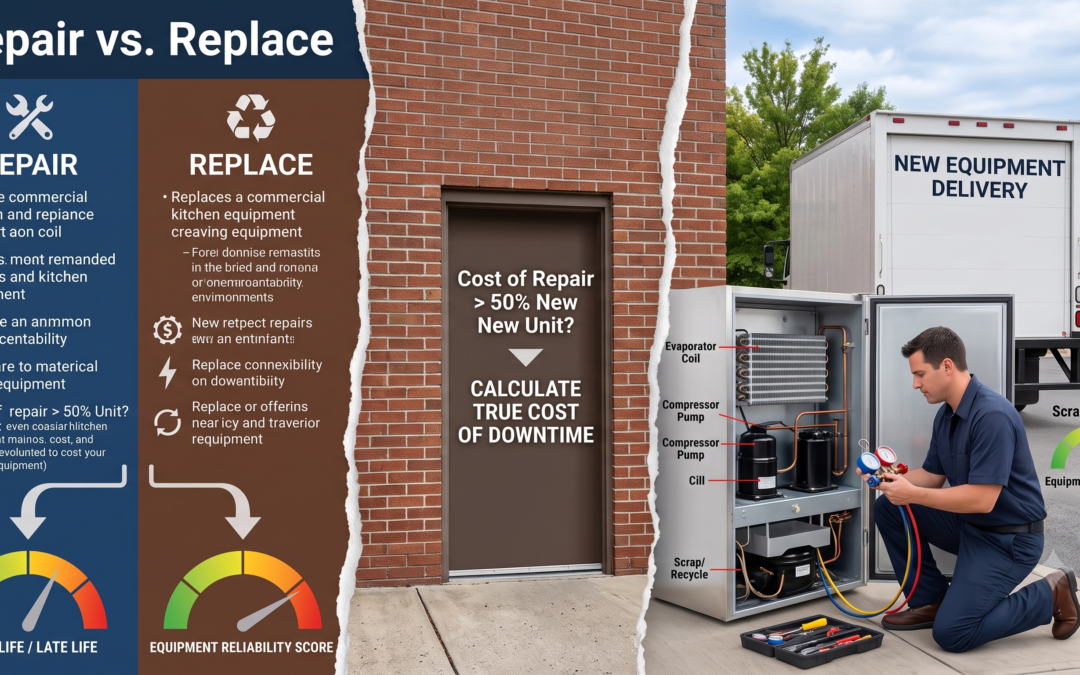
One of the most useful frameworks for the repair versus replace decision is the 50 percent rule: if the cost of a repair exceeds 50 percent of the cost of replacing the equipment, replacement is usually the better financial decision.
The logic is straightforward. Equipment that requires a repair costing half its replacement value is typically aging equipment with deteriorating components. Spending that amount to extend the life of a piece of equipment that is likely to need another significant repair in the near future is rarely a good use of capital.
The 50 percent rule is not absolute. A piece of specialty equipment that would take months to source and replace might justify a repair above that threshold simply because the operational disruption of replacement is too significant. But for standard commercial kitchen equipment with reasonable lead times, the rule is a reliable starting point for the conversation.
Signs That Replacement Is the Smarter Decision
Several patterns signal that a piece of equipment has crossed the line where ongoing repair no longer makes financial or operational sense.
Frequent failures are the clearest signal. Equipment that requires service calls every few months is not equipment that is being maintained. It is equipment that is deteriorating, and each repair is buying a shorter interval before the next failure.
Increasing energy consumption is another indicator that often goes unnoticed. Older commercial kitchen equipment runs less efficiently than current models, and the difference in energy cost over a year of operation can be substantial. A refrigeration unit drawing significantly more power than it should because of aging compressors or deteriorating seals is costing money every day it runs, independently of repair costs.
Parts availability is a practical constraint that forces the replacement decision for older equipment. When a piece of equipment is old enough that parts are no longer manufactured or require extended lead times to source, every future failure becomes a longer and more expensive repair. At that point, replacement on a planned schedule is significantly better than replacement forced by a failure with no parts available.
Operator safety concerns are a non-negotiable factor. Equipment that is failing in ways that create fire risk, electrical hazards, or food safety issues does not get repaired and monitored. It gets replaced.
Building a Replacement Planning Approach
The operators who handle equipment replacement most smoothly are the ones who are not surprised by it. They track equipment age, monitor repair history, and have a rough sense of which pieces of equipment are approaching the end of their expected service life before those pieces fail.
A simple equipment log that records the purchase date, expected service life, and repair history for each major piece of kitchen equipment gives operators the information they need to make replacement decisions proactively rather than reactively. When a piece of equipment starts accumulating repair costs that represent a significant percentage of its replacement value, that log makes the case for replacement before the next emergency forces the issue.
Planned replacement is almost always cheaper than emergency replacement. It allows time to evaluate options, negotiate pricing, schedule installation during a low-impact period, and train staff on new equipment without the pressure of a kitchen that is currently down.
DPoole Supports Michigan Restaurant Kitchens Beyond Cleaning
DPoole Commercial Kitchen Cleaning works with restaurants throughout Michigan, including Detroit, Grand Rapids, Lansing, Ann Arbor, Flint, and surrounding areas, to keep commercial kitchens operating cleanly, safely, and compliantly. Our services extend beyond hood cleaning and kitchen deep cleaning to support the broader operational picture that Michigan restaurant operators manage every day.
If your kitchen is dealing with equipment that is aging, frequently repaired, or showing signs that a replacement conversation is overdue, we can help you think through the maintenance picture alongside your cleaning and compliance program.
Contact DPoole to discuss your kitchen’s needs and schedule a service assessment.
FAQs
How do I know if my commercial kitchen equipment should be repaired or replaced?
The key factors are equipment age relative to expected service life, the cost of the repair relative to replacement cost, the frequency of past failures, and whether the current failure is isolated or part of a pattern of deterioration. The 50 percent rule, where a repair costing more than half of replacement value typically favors replacement, is a useful starting framework.
When does emergency restaurant equipment repair make sense?
Emergency repair is appropriate whenever a failure is creating an immediate operational or safety problem that cannot wait for standard scheduling. The premium cost of emergency service is almost always justified when the alternative is shutting down service or running without critical equipment.
What is the 50 percent rule for commercial kitchen equipment?
It is a general guideline that suggests replacement is usually the better financial decision when repair costs exceed 50 percent of the equipment’s replacement value. It is most reliable for standard equipment with reasonable lead times and less applicable to specialty equipment that is difficult to source quickly.
How often should commercial kitchen equipment be serviced?
Preventive maintenance schedules vary by equipment type, but most major commercial kitchen equipment benefits from annual professional inspection and service independent of reactive repairs. Regular maintenance extends equipment life, improves efficiency, and reduces the likelihood of unexpected failures during service.
What are the signs that commercial kitchen equipment needs to be replaced rather than repaired?
Frequent failures, increasing energy consumption, parts availability problems for older equipment, and any safety concerns that cannot be fully resolved through repair are all clear signals that replacement is the more appropriate decision.
Does DPoole handle commercial kitchen equipment repair directly?
DPoole’s core services cover commercial kitchen cleaning, hood and exhaust maintenance, and related compliance services. For equipment repair needs, we can discuss your full kitchen maintenance picture and help you connect with the right resources for your operation.