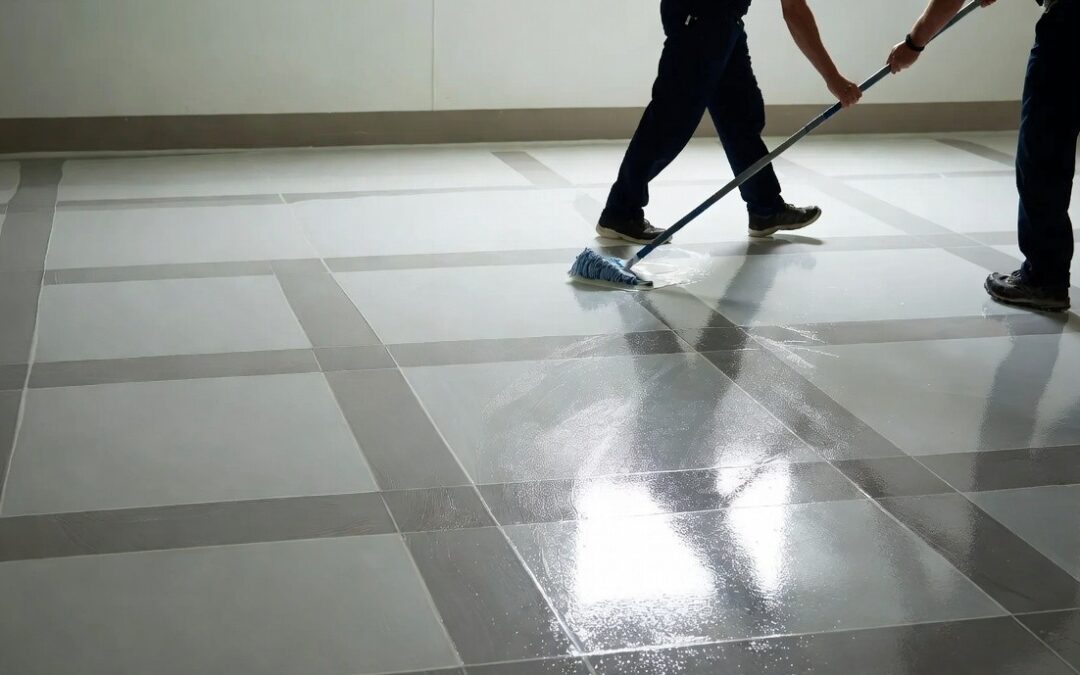
A commercial floor takes more abuse in a single week than most residential floors see in a year. Foot traffic, equipment, spills, cleaning chemicals, and heavy carts all wear down the surface over time. Without a protective layer maintaining that surface, floors deteriorate faster, become harder to clean, and start reflecting poorly on the business every time a customer or inspector walks through the door.
Commercial floor waxing is the service that addresses all of that. It is not a cosmetic upgrade. It is a maintenance process that protects the floor surface, extends the life of the flooring material, and keeps the space looking and performing the way a professional environment should.
This guide covers how the process works from start to finish, what stripping and waxing commercial floors actually costs, and why putting it on a regular schedule is one of the more straightforward maintenance decisions a business can make.
What Commercial Floor Waxing Actually Is
The term waxing is used broadly in the industry, but what most commercial floor services are applying is not traditional wax. It is a polymer-based floor finish, sometimes called floor coating, that bonds to the floor surface and creates a durable protective layer.
That layer does several things at once. It protects the underlying floor material from scratches, scuffs, moisture penetration, and chemical damage. It creates a surface that is easier to clean and maintain between full service appointments. And it produces the high-gloss appearance that is associated with a well-maintained commercial space.
Commercial floor wax is formulated for high-traffic environments in a way that consumer products are not. It is applied in multiple coats, each of which needs to dry fully before the next is added, and it is designed to be maintained through regular buffing and periodic recoating before the surface degrades to the point where a full strip and rewax is needed.
The floors most commonly treated with commercial floor waxing include vinyl composition tile, linoleum, and other resilient flooring types found in restaurants, retail spaces, healthcare facilities, schools, and office buildings. Not all flooring types are appropriate for wax or finish application, so confirming compatibility before service is a standard part of any professional assessment.
How the Strip and Wax Process Works
Understanding the full process helps explain why stripping and waxing commercial floors takes the time it does and why shortcuts in any stage compromise the result.
Step 1: Clearing and Prep
The area being serviced needs to be cleared of furniture, equipment, and obstacles. In a restaurant kitchen this may involve moving portable equipment. In a retail space it means clearing display fixtures from the sections being treated. Proper prep prevents the finish from being applied unevenly around obstacles or contaminated by items left on the floor.
Step 2: Stripping the Old Finish
Before a new finish can be applied, the old layers need to be removed. This is the strip phase. A chemical stripper is applied to the floor and allowed to dwell, softening the existing finish layers. A floor machine with a stripping pad then removes the softened material, which is collected and disposed of. This step is labor-intensive and is one of the primary drivers of service time and cost.
Stripping is necessary because old finish layers accumulate dirt, yellowing, and damage over time. Applying new finish over compromised old layers does not restore the floor. It traps the problem underneath and produces a surface that looks inconsistent and degrades faster than a properly stripped floor would.
Step 3: Neutralizing and Drying
After stripping, the floor is rinsed and neutralized to remove chemical residue that would interfere with the new finish bonding properly. The floor then needs to dry completely before any finish is applied. Rushing this step is one of the most common causes of finish adhesion problems and cloudy or uneven results.
Step 4: Applying the Finish Coats
Commercial floor wax finish is applied in multiple thin coats, typically three to five depending on the product and the desired result. Each coat is applied with a finish mop or applicator and allowed to dry fully before the next coat goes down. Applying coats too quickly or too thickly causes bubbling, streaking, and uneven gloss that requires correction.
Step 5: Final Buffing
Once the finish coats are dry, a high-speed burnisher is used to bring the surface to its final gloss level. This step compresses and hardens the finish, improving both appearance and durability.
What Stripping and Waxing Commercial Floors Costs
Pricing for commercial floor waxing varies based on several factors: the size of the area being treated, the current condition of the floor and how many old finish layers need to be stripped, the number of finish coats being applied, the type of flooring, and any prep or furniture moving required.
As a general range, strip and wax floor commercial pricing typically runs between $0.30 and $0.80 per square foot for standard commercial spaces. Larger jobs with straightforward layouts tend to land toward the lower end of that range. Smaller areas, floors in poor condition requiring additional stripping passes, or spaces with complex layouts that slow the work down tend to cost more per square foot.
For context, a 2,000 square foot retail floor might run between $600 and $1,600 for a full strip and wax service depending on condition and finish coat count. A restaurant dining room of similar size in good condition with fewer old finish layers to strip would likely fall in a similar range, while a kitchen floor with heavy contamination and multiple degraded finish layers could cost more due to the additional stripping labor involved.
Maintenance waxing, which involves applying one or two fresh finish coats over a floor that has been properly maintained without a full strip, costs significantly less and is the better option for floors that are being kept on a regular service schedule. The full strip and rewax becomes necessary when the finish has degraded past the point where maintenance coats can restore it.
How Often Commercial Floors Need to Be Waxed
Frequency depends on the amount of traffic the floor handles and how well it is maintained between full service appointments.
High-traffic commercial environments including busy restaurants, retail floors, and healthcare facilities typically need a full strip and wax once or twice a year. Between those full services, periodic buffing and maintenance recoating every one to three months keeps the surface in good condition and extends the interval before a full strip is needed again.
Lower-traffic environments like offices or back-of-house storage areas may be able to go longer between full strip and wax services, with less frequent maintenance buffing in between.
The indicator that a floor needs a full strip rather than a maintenance coat is the condition of the existing finish. Yellowing, cloudiness, visible scratches through the finish layer, or areas where the finish has worn through completely all signal that maintenance coating is no longer sufficient and a full strip and rewax is the right service.
Why Regular Commercial Floor Waxing Protects More Than the Surface
Beyond appearance, a properly maintained floor finish protects the business in several practical ways.
A waxed floor is easier to clean. The finish layer prevents contaminants from penetrating the flooring material, which means routine mopping removes surface soil more effectively and the floor stays cleaner between deep services.
A waxed floor is safer. A fresh finish coat provides a slip-resistant surface when properly applied. A floor with degraded or uneven finish, by contrast, can have inconsistent traction that creates slip hazards, particularly in food service environments where spills are common.
A waxed floor lasts longer. Flooring materials that are protected by a properly maintained finish layer are not in direct contact with the abrasion, moisture, and chemical exposure that degrade them. That protection meaningfully extends the life of the floor itself, deferring the significantly higher cost of floor replacement.
DPoole Provides Commercial Floor Waxing for Michigan Businesses
DPoole Commercial Kitchen Cleaning provides commercial floor waxing and strip and wax services for restaurants, food service facilities, and commercial spaces throughout Michigan, including Detroit, Grand Rapids, Lansing, Ann Arbor, Flint, and surrounding communities.
Whether your floor needs a full strip and rewax to restore a surface that has been neglected or a maintenance program to keep a well-maintained floor in top condition, we provide professional service with the documentation and scheduling consistency that commercial operations need.
Contact DPoole to discuss your floor maintenance needs and get an assessment for your space.
FAQs
What is commercial floor waxing and what floors does it work on?
Commercial floor waxing is the application of a polymer-based floor finish to resilient flooring types such as vinyl composition tile and linoleum. It protects the floor surface, improves appearance, and extends flooring life. Not all floor types are compatible, so a professional assessment should confirm suitability before service.
How much does strip and wax floor service cost for a commercial space?
Pricing typically ranges from $0.30 to $0.80 per square foot depending on floor size, condition, finish coat count, and layout complexity. Maintenance waxing between full strip services costs less and is appropriate for floors on a regular maintenance program.
How long does a commercial floor waxing service take?
Duration depends on the size of the area and the number of finish coats being applied. A full strip and wax for a mid-sized commercial space typically takes several hours, as each finish coat needs to dry fully before the next is applied. Scheduling service during off-hours minimizes operational disruption.
How often do commercial floors need to be stripped and waxed?
High-traffic commercial environments typically need a full strip and wax once or twice a year, with maintenance buffing and recoating every one to three months in between. Lower-traffic spaces may go longer between full strip services.
What is the difference between stripping and waxing and maintenance waxing?
A full strip and wax removes all existing finish layers before applying fresh coats. Maintenance waxing applies one or two fresh coats over an existing finish that is still in good condition. Maintenance waxing is appropriate for floors being kept on a regular schedule. A full strip becomes necessary when the existing finish has degraded past the point where additional coats can restore it.
Can commercial floor waxing be done while the business is open?
It is possible in some spaces, but most commercial floor waxing services are performed during off-hours to allow proper drying time between coats and to avoid foot traffic on fresh finish. Scheduling service overnight or during a closed period produces better results and eliminates disruption to operations.