One of the most common points of confusion for Ann Arbor restaurant owners is understanding the difference between hood cleaning and full commercial kitchen cleaning, and more importantly, knowing which one their operation actually needs.
They are not the same service. They do not cover the same surfaces. And choosing the wrong one, or assuming one replaces the other, is how kitchens end up with compliance gaps that show up at exactly the wrong moment.
This guide breaks down what each service covers, how they differ, when each one is appropriate, and how Ann Arbor restaurants can use both as part of a complete commercial kitchen cleaning services approach that holds up under inspection.
What Hood Cleaning Actually Covers
Hood cleaning, more precisely called kitchen exhaust cleaning, addresses the exhaust system that captures and removes grease-laden vapor produced during cooking. That system includes several components, all of which accumulate grease and all of which need to be cleaned as part of a compliant service.
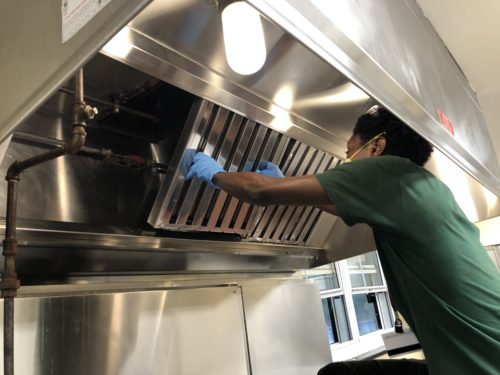
A thorough restaurant hood cleaning in Ann Arbor covers the hood canopy and filters, the plenum area behind the filters, the interior duct surfaces running from the hood to the roof, and the rooftop exhaust fan housing and blades. Done correctly, it cleans the full exhaust path rather than just the surfaces that are easy to reach.
Hood cleaning is a code-driven requirement. Michigan’s mechanical code ties commercial kitchen exhaust systems to NFPA 96, which sets minimum cleaning frequencies based on cooking volume and type. High-volume operations require monthly service. Moderate-volume kitchens require quarterly service. That schedule is a legal minimum, not a preference, and inspectors evaluate service records against it during fire marshal and health department inspections.
What hood cleaning does not cover is everything outside the exhaust system: cooking equipment surfaces, kitchen walls, ceilings, floors, or any other surface in the kitchen environment. That is where full kitchen cleaning comes in.
What Full Kitchen Cleaning Actually Covers
Full commercial kitchen cleaning is a broader service that addresses the kitchen environment beyond the exhaust system. Depending on the scope of service, it can include deep cleaning of cooking equipment exteriors and interiors, fryer breakdowns and degreasing, grill and oven cleaning, hood exterior surfaces, kitchen walls and backsplash areas, ceiling tiles and overhead surfaces where grease vapor settles, floor drains and surrounding areas, and refrigeration unit exteriors.
This type of service is typically scheduled less frequently than hood cleaning, often monthly or quarterly depending on the kitchen’s volume and condition, and is designed to address the grease, carbon, and contamination that accumulates on surfaces throughout the kitchen rather than specifically inside the exhaust system.
Full kitchen cleaning is not always code-mandated in the same way hood cleaning is, but it has direct implications for health inspection compliance. A kitchen that passes its fire marshal inspection for hood cleaning but shows heavy grease accumulation on cooking equipment, walls, or ceilings during a health department visit is still facing a compliance problem. Both dimensions matter.
Side by Side: Hood Cleaning vs Full Kitchen Cleaning
| Hood Cleaning | Full Kitchen Cleaning | |
| What it covers | Exhaust system: hood, filters, plenum, ducts, rooftop fan | Cooking equipment, walls, ceilings, floors, drains, hood exterior |
| Primary driver | Fire code compliance, NFPA 96 | Health inspection compliance, operational hygiene |
| Frequency | Monthly to quarterly based on cooking volume | Monthly to quarterly based on kitchen condition |
| Who inspects it | Fire marshal, local fire authority | Health department |
| Documentation required | Yes, service records and hood sticker | Recommended, supports health inspection history |
| Can one replace the other | No | No |
| Typical duration | 2 to 6 hours depending on system size | 4 to 12 hours depending on kitchen size and condition |
The most important line in that table is the last one before duration: neither service replaces the other. A kitchen that only schedules hood cleaning is leaving health inspection exposure on the table. A kitchen that only schedules full kitchen cleaning is not meeting its fire code obligations. Both are necessary, and for most Ann Arbor restaurants, both should be part of the same maintenance calendar.
Why Ann Arbor Restaurants Need Both
Ann Arbor’s food service environment includes everything from high-volume campus-area restaurants serving large student populations to independent neighborhood spots running lighter menus. Across that range, the compliance picture is the same: fire code requirements and health inspection standards operate independently of each other, and a kitchen needs to satisfy both.
The fire marshal evaluates the exhaust system and asks for hood cleaning documentation. The health department evaluates the overall kitchen environment and looks at equipment, surfaces, and general sanitation conditions. These are separate inspections conducted by separate authorities, and a strong performance in one does not carry over to the other.
For a busy Ann Arbor restaurant running multiple shifts, the practical schedule often looks like monthly kitchen exhaust cleaning in Ann Arbor to meet NFPA 96 frequency requirements for high-volume cooking, combined with quarterly or monthly full kitchen cleaning to keep equipment and surfaces in the condition health inspectors expect. For a lighter-volume operation, quarterly hood cleaning combined with a periodic deep clean may be sufficient.
The right combination depends on the kitchen’s cooking volume, menu type, equipment load, and the specific compliance expectations of the local authorities that inspect it.
The Overlap Zone: What Falls Between Both Services
There are surfaces and components that sit at the boundary between hood cleaning and full kitchen cleaning, and understanding where they fall matters for making sure nothing gets missed.
The exterior of the hood canopy, the visible surface facing into the kitchen, is typically addressed during a full kitchen clean rather than a hood cleaning. Hood cleaning focuses on the interior exhaust path. If a kitchen is only scheduling hood cleaning and no full kitchen service, the exterior hood surface may be accumulating grease that is visible during a health inspection but not being addressed by either service.
Kitchen ceiling tiles and overhead surfaces are another area that falls outside the scope of standard hood cleaning. Grease vapor that escapes the exhaust system during high-volume cooking periods settles on ceiling tiles, light fixtures, and overhead structures. Over time that accumulation becomes both a health inspection issue and a fire risk in its own right. A full kitchen cleaning program that includes ceiling and overhead surface service addresses this gap.
How to Build the Right Cleaning Schedule for Your Ann Arbor Kitchen
The starting point for any Ann Arbor restaurant is knowing which NFPA 96 frequency category applies to the kitchen’s cooking volume. That determines the hood cleaning interval. From there, the full kitchen cleaning frequency is built around the kitchen’s actual condition, equipment load, and health inspection history.
A few questions worth asking when building that schedule: How often is your kitchen cited for surface or equipment conditions during health inspections? Are there areas of the kitchen that staff report as difficult to keep clean between deep cleans? Has your hood cleaning service been covering the full exhaust path, including the ductwork and rooftop fan, or only the visible hood surfaces?
Answering those questions honestly usually reveals where the current program has gaps and what needs to be added to close them.
For Ann Arbor restaurants specifically, working with a provider that handles both hood cleaning and broader kitchen cleaning services under the same program is the most practical approach. It reduces scheduling complexity, ensures nothing falls between services, and gives management a single point of contact for documentation across both compliance areas.
Visit our restaurant hood cleaning Ann Arbor page for details on our exhaust cleaning service in the Ann Arbor area, or see our full restaurant hood cleaning Michigan page for statewide service coverage and a complete overview of what a compliant hood cleaning program looks like.
FAQs
What is the difference between hood cleaning and commercial kitchen cleaning in Ann Arbor? Hood cleaning addresses the exhaust system, including the hood, filters, plenum, ductwork, and rooftop fan, and is required by fire code under NFPA 96. Full commercial kitchen cleaning covers the broader kitchen environment including cooking equipment, walls, ceilings, and floors, and is evaluated during health department inspections. Neither service replaces the other.
How often do Ann Arbor restaurants need hood cleaning? Under NFPA 96, high-volume operations require monthly service and moderate-volume operations require quarterly service. The right frequency depends on the kitchen’s actual cooking volume and type, not a generic default.
Does a full kitchen cleaning satisfy hood cleaning compliance requirements? No. Hood cleaning compliance requires service of the exhaust system interior, including ductwork and the rooftop fan, with documentation that meets fire code standards. A general kitchen clean does not address those components and does not satisfy NFPA 96 requirements.
What surfaces does a full commercial kitchen cleaning cover in Ann Arbor? Scope varies by provider and service agreement, but typically includes cooking equipment exteriors and interiors, fryers, grills, ovens, kitchen walls and backsplash areas, ceiling surfaces, and floor drains. It addresses grease and contamination accumulation throughout the kitchen environment rather than specifically inside the exhaust system.
Can one provider handle both hood cleaning and full kitchen cleaning for an Ann Arbor restaurant? Yes, and for most restaurants it is the more practical approach. Using a single provider for both services simplifies scheduling, ensures consistent documentation, and reduces the risk of surfaces falling between service scopes.
What documentation should Ann Arbor restaurants keep for hood cleaning compliance? Service records should include the date of cleaning, the provider’s name and contact information, a description of the system components cleaned, and a service sticker near the hood noting the last and next service dates. Records should be accessible on-site for fire marshal review at any time.