Most people who run a commercial kitchen know they need a grease trap. Fewer know what is actually happening inside it between cleanings, and that gap in understanding is usually what leads to backups, odors, inspection flags, and emergency service calls.
This breakdown walks through the internal process stage by stage: what enters the trap, how it separates, what builds up over time, and what happens when it is left too long. Understanding the timeline makes it a lot easier to see why grease trap cleaning in Michigan is not just a maintenance checkbox. It is a system that needs active management.
What a Grease Trap Is Actually Doing
Before getting into the buildup stages, it helps to understand what the trap is designed to do.
Wastewater from a commercial kitchen carries a mix of fats, oils, and grease, commonly called FOG, along with food solids, detergents, and water. If that mixture went straight into the municipal sewer, it would cool, solidify, and eventually cause serious blockages downstream. Grease traps exist to intercept the FOG before it travels that far.
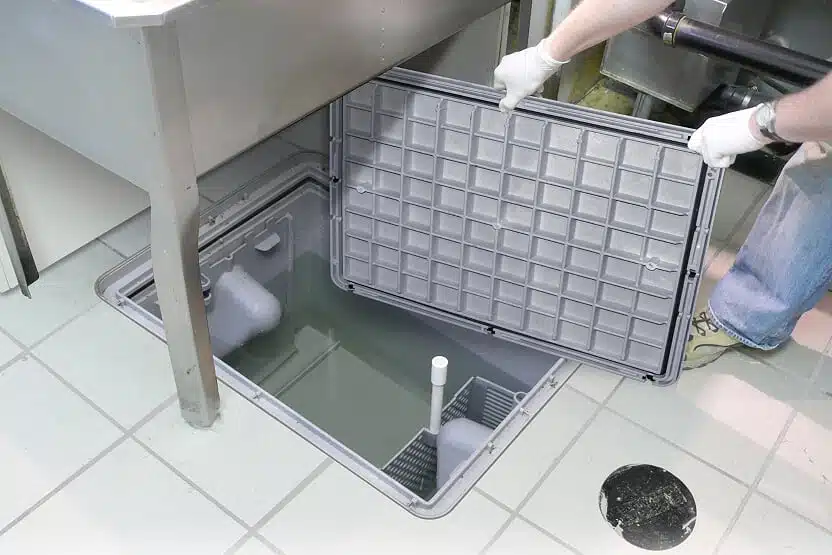
The trap works on a simple principle: FOG is lighter than water, so it floats. Food solids are heavier, so they sink. The trap holds the wastewater long enough for that separation to happen, trapping the grease layer at the top and the sludge at the bottom while allowing the relatively cleaner water in the middle to flow out through the outlet pipe.
It is an elegant system, but it only works well when it has enough room to do its job.
Stage 1: Fresh Separation (Days 1 to 7 After Cleaning)
Right after a proper cleaning, the trap is empty and working at full efficiency.
As wastewater enters, the three-layer separation begins almost immediately. FOG rises to the surface and forms a thin floating layer. Food particles and solids drift down and start collecting as a soft layer of sludge at the bottom. The middle zone, relatively clear water called the effluent, flows out toward the sewer line.
At this stage, the system is doing exactly what it was designed to do. Odors are minimal. Flow is unrestricted. There is nothing to worry about.
But accumulation starts on day one.
Stage 2: Early Buildup Begins (Weeks 1 to 3)
This is where most operators stop paying attention, because the kitchen still feels and smells completely normal.
The grease cap at the top is thickening with each service. Every time hot water and cooking waste enter the trap, more FOG is added to the floating layer. The sludge layer at the bottom is also growing, slowly but consistently. Bacterial activity begins to increase as organic material accumulates. Certain bacteria break down the FOG, which sounds helpful but produces hydrogen sulfide gas as a byproduct. That gas is what eventually becomes the rotten-egg odor that signals a trap overdue for service.
The trap is still functional at this point, but its capacity to separate effectively is already starting to shrink.
Stage 3: Active FOG Accumulation (Weeks 3 to 6)
By now the grease cap has become a defined, solid layer. Depending on how much cooking volume the kitchen handles, it can be several inches thick. The sludge at the bottom is compacting.
This is the phase where the 25 percent rule becomes relevant. Many jurisdictions and service guidelines use it as a benchmark: when the combined depth of the floating grease layer and the bottom sludge equals 25 percent or more of the total liquid depth, the trap needs to be pumped. At that threshold, the trap no longer has enough room to allow proper separation, and FOG starts passing through into the outlet pipe.
For high-volume kitchens, including busy restaurants, cafeterias, and food processing operations, this stage can be reached in four to six weeks. For lower-volume locations, it may take longer. But it always arrives.
Stage 4: System Stress and Early Warning Signs (Weeks 6 to 10)
When FOG accumulation reaches the point where it is escaping into the outlet, the problems start becoming visible.
Drains may begin to slow. A persistent odor, the hydrogen sulfide produced by bacterial growth in the grease trap, starts to become noticeable in the kitchen or near floor drains. In some cases, small amounts of grease begin showing up in places they should not be.
This is also the phase where a grease trap inspection is most likely to reveal a problem. Inspectors who check kitchen waste systems are trained to look for signs of an overloaded trap. Slow drainage, odor, and visible grease in the outlet line are all flags. A trap that has been neglected past this point is a liability both for compliance and for the kitchen’s day-to-day operation.
Stage 5: Failure and Backup Risk (Beyond 10 to 12 Weeks for High-Volume Kitchens)
A trap that has gone well beyond its service interval is no longer functioning as a separator. The grease cap and sludge layer have consumed so much of the trap’s volume that FOG is passing through freely. At this point, the trap is essentially acting as a holding tank for a problem that is already heading downstream.
Backups become a real risk. Grease that has solidified in the outlet pipe or in downstream lines does not move easily. When a backup occurs, it usually means emergency service, potential health department involvement, and revenue loss while the kitchen is out of operation.
The bacterial growth inside a severely overloaded trap also intensifies. The odor is not just unpleasant. It indicates a biologically active environment that can affect air quality in the kitchen and create conditions that complicate cleaning.
Getting to this stage turns what would have been a routine service call into a much bigger, more expensive job.
Why Cooking Volume Changes Everything
One of the most important variables in the grease trap buildup timeline is how much the kitchen actually cooks.
A small cafe doing light breakfast service will accumulate FOG at a much slower rate than a busy full-service restaurant running three shifts. A food processing facility handling high volumes of animal fats or plant oils will reach critical accumulation faster than either of them.
This is why a fixed “clean it once a year” rule does not work for most commercial kitchens. The right cleaning frequency for grease trap cleaning in Michigan depends on cooking type, oil usage, kitchen volume, and the specific capacity of the trap. A service provider who inspects the trap and evaluates actual buildup rates can give a much more accurate recommendation than a generic schedule.
What Proper Cleaning Actually Resets
Understanding what happens between cleanings makes it easier to appreciate what a proper service actually does.
Professional grease trap cleaning does not just skim the surface layer. It removes the full grease cap, pumps out the accumulated sludge, clears the inlet and outlet baffles, and inspects the trap components for wear or damage. Done correctly, it resets the system back to stage one: full capacity, efficient separation, and minimal bacterial load.
Partial cleaning, where technicians only remove the top layer or skip the sludge, shortens the effective service interval significantly and often leaves the bacterial population intact. This is one reason why documentation matters. A proper service record shows what was actually removed, not just that someone showed up.
Keeping the System Ahead of the Problem
The pattern that tends to cause the most operational and compliance pain is reactive scheduling, where operators wait for an odor, a slow drain, or an inspector’s flag before booking service.
A more consistent approach means knowing your kitchen’s approximate buildup rate and scheduling service before the trap reaches the point of system stress. It also means keeping records organized so that during a grease trap inspection, you can show a clear history of service and documentation rather than scrambling to remember when the last cleaning happened.
For Michigan operators specifically, kitchen waste system compliance is part of a broader set of expectations that includes hood and exhaust maintenance, suppression system service, and fire-safety recordkeeping. Grease trap management fits into the same compliance mindset, and the same principle applies: proactive service is almost always cheaper and less disruptive than reactive cleanup.
Ready to Get Back Ahead of Your Cleaning Schedule?
If you are not sure where your trap is in the buildup timeline, or if it has been longer than it should be since the last service, DPoole Commercial Kitchen Cleaning can help. We handle grease trap cleaning in Michigan for restaurants, facilities, and food processing operations, with thorough service, proper documentation, and honest assessments of your actual cleaning frequency needs.
Do not wait for a backup or an inspection flag to find out where things stand.
FAQs
How fast does a grease trap fill up?
It depends on cooking volume. High-volume kitchens can reach the 25 percent threshold, the point where FOG begins escaping into the outlet, in four to six weeks. Lower-volume operations may take longer, but all traps accumulate over time.
What causes grease trap odor?
The smell comes from hydrogen sulfide gas produced by bacterial growth in the trap as organic material breaks down. It is a sign that FOG accumulation and biological activity have reached a level that needs attention.
What is the 25 percent rule for grease traps?
It is a common service benchmark. When the combined depth of the grease cap and bottom sludge equals 25 percent or more of the trap’s total liquid depth, the trap should be pumped. At that point, separation efficiency drops significantly.
Does grease trap cleaning in Michigan follow specific requirements?
Local municipalities and wastewater authorities in Michigan often set their own grease trap maintenance requirements, including minimum service frequency and documentation standards. It is worth confirming your local requirements in addition to following service-based best practices.
Can I tell if my grease trap needs cleaning without opening it?
Slow drains, persistent odors near floor drains or in the kitchen, and any sign of grease backup are the most common indicators that a trap is overdue. But by the time those signs are visible, the trap is usually already past the point of optimal function.
What happens if a grease trap is never cleaned?
Eventually the trap loses its ability to separate FOG at all, and grease passes freely into downstream sewer lines. This leads to blockages, backups, potential fines from the municipal wastewater authority, and significantly more expensive remediation than routine cleaning would have cost.